Orb Evasion Challenge
Reviews
Orb Evasion Challenge succeeds by doing one thing well: testing your ability to stay calm under pressure. The minimalist visuals keep distractions to a minimum, letting you focus entirely on the falling spheres. The difficulty curve feels natural, gradually pushing you to improve without feeling unfair. Controls are tight and responsive, which is essential for a game built on split-second decisions. While it lacks variety in modes or objectives, the core loop is strong enough to keep you coming back for just one more round. It is a solid choice for anyone looking to sharpen their reflexes in a low-commitment format.
Description
Core Gameplay Loop
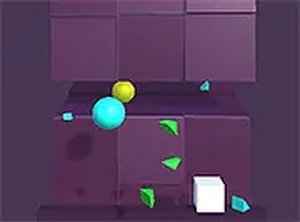
At its heart, Orb Evasion Challenge is a test of precision and anticipation. Players control a small block that moves laterally across the bottom of the screen. From above, spheres of varying sizes descend at unpredictable intervals. The goal is straightforward: keep the block clear of all incoming objects. There are no power-ups or complex mechanics to learn. Success depends entirely on how well you read the falling patterns and adjust your position accordingly. The game strips away distractions, leaving only the pure challenge of avoidance.
Pattern Recognition & Difficulty Curve
What sets Orb Evasion Challenge apart from simpler avoidance games is its dynamic difficulty scaling. Early rounds introduce a slow, predictable stream of spheres, allowing new players to get comfortable with the controls. As the session continues, the game introduces faster descent speeds, larger clusters of spheres, and irregular timing gaps. Some spheres may fall in straight lines, while others follow slight curves. This variety keeps the experience from becoming repetitive. Players quickly learn that memorizing patterns is less important than staying adaptable and ready to react in the moment.
Visual Design & Atmosphere
The game presents a clean, uncluttered 3D environment that focuses attention on the action. The block and spheres are rendered with simple but appealing shapes, and the background uses subtle gradients to reduce eye strain during longer play sessions. There are no distracting animations or flashy effects. The design philosophy here is clarity: every element on screen serves a purpose. This minimalist approach makes it easy to track multiple spheres at once, which is essential as the difficulty ramps up. The overall aesthetic supports the gameplay without overwhelming the senses.
Session Structure & Replay Value
Orb Evasion Challenge is built for short, repeatable sessions. There are no levels to unlock or story to follow. Each attempt is a self-contained run where the only goal is to survive longer than your last try. This structure makes the game ideal for quick breaks or moments when you have a few minutes to spare. Because the sphere patterns are procedurally generated, no two runs feel exactly the same. The lack of a fixed endpoint means players can always push for a new personal best, which adds a layer of long-term motivation beyond simple survival.
Accessibility & Control Scheme
The controls are designed to be immediately intuitive. Players can use either the keyboard arrow keys or a mouse to move the block left and right. Both input methods offer responsive, low-latency feedback, which is critical for a game that demands quick reactions. There is no tutorial or practice mode because none is needed. The simple control scheme ensures that players of all ages and gaming backgrounds can start playing without any prior instruction. This accessibility is a key strength, making the game suitable for family-friendly environments or casual gaming sessions.